
Wednesday 22 September
Today's travelling took us through a pass in the Toros mountain range and across wide open plains toward the Mediterranean coast of Turkey. Much of the flat land was planted in citrus and other fruits, melons, tomatoes, peppers, chilli, cotton and corn. Vast areas were under plastic "glass houses". It amazes us that the population of Turkey is fed at all by the relatively small cultivated area of Turkey (apart from countless miles of olive trees) and equally amazed that so much meat is eaten here when we have seen no more than a few dozen cows, no sheep, no pigs and maybe a few hundred goats throughout the whole of our travel. It seems not a lot to go around a population of 73 million.
We had our lunch near an irrigation lake where a breeze was a welcome relief in the about 32 deg heat then drove another hour or so to Perge - another city which has not been occupied since the earthquake-prone 11th Century but whose history goes back about 3000 years and includes some time as being the main city of the area. It originally also had a port (like Ephesus, it is now about 3.5 miles inland). It was part of Alexander the Great's empire around 340BC and occupied by the Romans for hundreds of years once the King Pergamum bequeathed it to his friends the Romans in his will (feel free to correct me if I got that story wrong, I have heard so many stories of conquered, destroyed or rebuilt cities in the last couple of months, I may get mixed up). Since the Romans built over the top of and extended the original city of Perge the only feature remaining from pre-Roman times is two towers forming the gate to the old city.  These are currently under re-construction by a Turkish archaeology team. The main (Roman) "street" is a clear feature and a second major street of the Roman city is about to be excavated. The usual constructions of a Roman city - the Gate,
 the Agora,
 the Bath house,
 a Stadium (now collapsed),

 a central "main street"
 were apparent but, of course, mostly in ruins. I know they just look like fancy broken rocks, but they are starting to make more sense now after seeing so many Roman remains. This whole experience was so much pleasanter than the two previous buried cities as the crowds were much less today - although the heat from the sun was just as great.
These are currently under re-construction by a Turkish archaeology team. The main (Roman) "street" is a clear feature and a second major street of the Roman city is about to be excavated. The usual constructions of a Roman city - the Gate, the Agora, the Bath house, a Stadium (now collapsed), a central "main street" were apparent but, of course, mostly in ruins. I know they just look like fancy broken rocks, but they are starting to make more sense now after seeing so many Roman remains. This whole experience was so much pleasanter than the two previous buried cities as the crowds were much less today - although the heat from the sun was just as great.We drove on to the city of Antalya where we now spend two nights. This hotel has reliable and free internet wifi so we should be able to update again tomorrow night as well. We are planning to have a more relaxing start tomorrow as we have a day "free" but hope to visit the Museum (which has some of the statues which were rescued from Perge) and we may even get a dip in the Mediterranean.

 Unfortunately, their goods were exclusively jackets and as Glenda was only looking for a handbag they didn't get a deal out of us. However, this still took up the first 1.5 hours of the day.
 and the travertina beside it. This site was again a mostly flattened archeological site (much of the city had been destroyed by large earthquakes in the 11th century??). It was smaller than Ephesus but it seemed much larger to us because we were able to view most of it at once when we climbed the hill to where the amphitheatre was located.
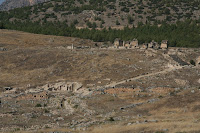

 Hierapolis is currently undergoing restoration by Italian archeaologists and a lot of work has already been done on the amphitheatre stage section.
 It was very hot and after walking back down the hill we welcomed the opportunity to walk through the water which was pooled in the travertina area (the travertina is made from calcium deposits which have formed marble terraces on the hillside) to give our feet a bit of a cool down.

 On camera the calcium terraces appear like snow (but with about 30 degree temperatures surrounding you!) and the name Pamukkale means "Cotton Castle" or "Cotton Fort". Although we had nearly 2 hours there, we still did not have enough time to visit the museum, which is located in one of the old Roman bath houses.


 This is reportedly the house where she spent her final years under the protection of the Apostle John and where she died. It was a quiet and peaceful spot but once again the regular row of souvenir stands was apparent as we left the site and, surprisingly, it seemed to qualify to have its own police station.


 and has had a number of incarnations as a city over about 1000 years.
 followed by the obligatory selling show
 but managed to leave without another carpet in our possession (that is not to say that we weren't sorely tempted by some of the beautiful rugs but just couldn't justify it).
 (which reputedly used to contain 200,000 parchment scrolls, many of which went to the library in Alexandria as part of Mark Anthony’s wedding gift to Cleopatra in 42 BC),
 (currently moved and living in Berlin),


 From here we will drive to


 , ANZAC cemetery,
 Lone Pine Cemetery
 and Chunuk Bair

 .
 and travelled on to


 ,


 followed by Haga Sophia (which used to be a church, then a mosque, and is now a museum),


 and then back to Sultanahmet Camii (Blue Mosque)

 and the Grand Bazaar.
